UX of Skin
- Rayanne Ellis
- Jan 4, 2024
- 5 min read
Updated: Jan 11, 2024
Design a way to express the skin/world interface
Timeframe: Monday 27 November – Sunday 10 December
Team members: Ale, Teddi, Min, Ananya and Rayanne
Research methods: Speed Dating and Creative Toolkit
Week 1 Monday 27 November - Sunday 3 December
Ideation
We collectively looked into skin and it’s connection with the world asynchronously documenting our findings on a shared figma board. We met online to present our ideas and collectively voted narrowing down to Skin, Emotions and Identity.


Starting from top left: Fig. 1 Ananya’s ideas, Fig. 2 my ideas, Fig. 3 Min’s ideas and Fig. 4 Ale ideas
Storyboarding
We went on to create fictional storyboards on skin, emotions and identity. This speculative design enabled our imaginations and those of participants to flow freely when exploring the concepts. We created one storyboard together so we were all clear on the process. We then created one each.


Starting from top left: Fig. 5 Emotions through skin by Teddi. Fig. 6 Identity through skin by Min. Fig. 7 Skins interaction with the environment by all. Fig. 8 Emotions through skin by me. Fig. 9 Identity through skin by Ale and Ananaya.
Speed Dating
Ananya suggested we get out of the university and conduct the Speed Dating with the staff and students at her halls. We prepared beforehand, I shared info on Speed Dating and we decided on two focus questions
How do you see your own identity and emotions through your skin? - to be asked before the session
What do these concepts cause you to think of in terms of skin, identity and emotions? - to be asked after the session.
We also gave ourselves set roles for the Speed Dating to ensure we facilitated the session whilst documenting it effectively. We interviewed 6 different women and affinity sorted the findings.

Fig. 10 images of Speed Dating interviews with 5 of the participants.

Fig. 11 Affinity Sorting of findings with key themes highlighted.


Fig. 12, 13 and 14 quotes from Speed Dating participants
From our research we created our initial concept for exploration and presented our work back to the class.

Fig. 15 initial Concept
What I learnt
I took the benefits of asynchronously working and voting on ideas from the group work on digital shadows, i think asynchronous at the start gives us all space to understand the brief and share ideas before collaboration. Whilst voting helps narrow down focus quickly, enabling the time to explore a couple of ideas well rather than a lot poorly.
Going out of the university to conduct the research was not only refreshing it also made us more professional as we planned our approach, considered ethics and ran the sessions in a focused, efficient way. As a result, we gained new perspectives and increased our experience as researchers.
During the presentation we were praised for our approach to storyboarding and going out of the university. However, it was also clear our concept was too broad we needed to identify which women, which negative emotions, what interactions and which parts of the skin. We also needed to ensure we didn’t lose skin in our our exploration of emotions.
Week 2 Monday 4 November - Sunday 10 December
Narrowing concept
To narrow down our concept we went away to answer the following questions:
Why women?
What negative emotions?
What interactions
what part of the skin?
I was inspired by the speed dating findings that suggested skin can be a mask to hide our inner vulnerabilities. I was intrigued into why this was necessary and found a survey by the Women and Equality committee in the House of Commons (2020). From this I concluded society regularly presents women, transpeople and peoples with disabilities an unrealistic image of “perfection” which leads to negative emotional e.g. anxiety and shame.
We were also intrigued into the link between anxiety, body image and skin picking which we’d discussed on Thursday. Min went on to find skin picking including squeezing, rubbing, biting and pulling is more common in women and can be linked to feelings of anxiety. We decided we wanted to explore this further in our creative toolkit exercise. With the prompt “create a skin you can interact with when anxious”.
Creative toolkit
Teddi arranged for us to go to the Queer Britain Museum to conduct our creative toolkit. We met at uni beforehand to go through and select the materials for the toolkit. We also discussed how we wanted to run the session setting out clear roles, a learning from the previous research. Mine was to take notes and record the session. I created a table to collate our findings following each session.
During the session we decided to change the prompt to “create something you can interact with when anxious?” To see if skin was still significant when we don’t lead people to focus on it.

Fig. 16 Creative toolkit set up, location and participants involvement

Fig. 18 All of the participants creations

Fig. 18 Some of participants creations and related quotes

Fig. 19 Our thoughts after each session
Creating prototypes and testing
Following analysis of the findings we decided to pivot away from anxiety and instead focus on the self soothing aspect. To understand anxiety and to help with it we felt this would require much more research and we would not be able to do it justice in the time we had.
We started to make prototypes that people could use instead of picking at their skin and to express the unconscious actions we have with our skin.
We took inspiration from the creative toolkit outputs and created wearables for areas where people may pick at skin and things they could have in front of them. We gave these to participants to try, they enjoyed the satisfaction of playing with them and shared their own stories of skin picking but felt the texture was not very realistic and needed to be more like skin.


Fig. 20, 21 & 22 prototypes
Exploring materials and creating final prototype
We regrouped and decided to change the materials to something more skin like. We also decided to make our prototype bigger to make the interaction more immersive and soothing. We explored latex, slime and jelly and we decided on using silicone to make thin sheets with different textured underneath.


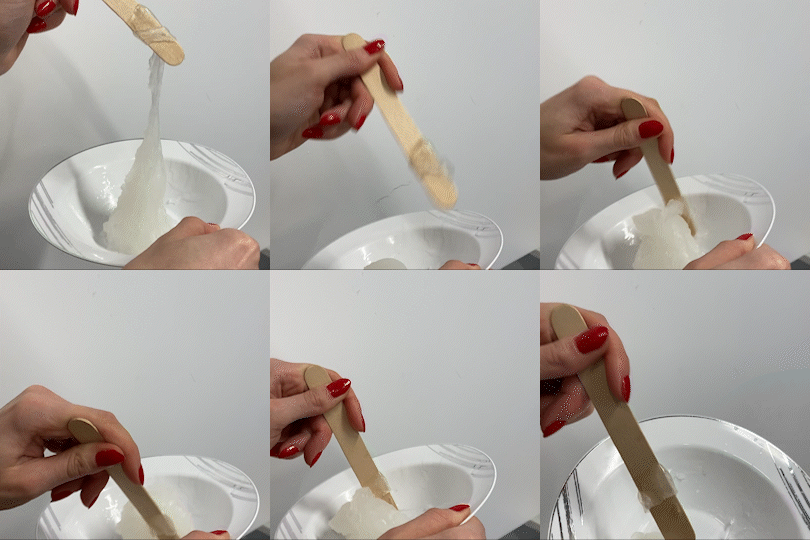
Fig. 23 & 24 making the silicone sheets to create the skin texture.
We also created an orange peel glove so people could try an interactions on their body as well something that was an important finding in the creative toolkit sessions. We ask for participants to play with our “fake skin” during our presentation and got their feedback at the end.


Fig. 25, 26, 27, 28 and 29 images of our final experience
What learnt
Following on from week 1 I improved our analysis process during research sessions, by creating an analysis table and facilitating a debrief after each session. This really helped us to clearly see key themes and iterate for the next session. I also set up a tripod to capture both video and audio so we could capture body language which was missing from the speed dating audio recordings.
During the presentation we were praised for spending time finding a material that felt like skin. This was the first time I really delving into the type of material used for my experience. The process showed me how significant a factor material can be in creating an experience. This was a critique of my previous work on the UX of pigeons and it was great to improve on it in this brief.
After the presentation we received the following feedback “I like how you’ve found the little things in our daily life and expanded it” and I agree I think it was the first time I worked to a micro level since working on UX of Air and exploring Popcorn. I think we were far more successful because we ensured there was a clear thread and we used the research to guide us throughout. Something I will ensure to do in the future.
Tonicha mentioned the next phase could be to go back to the people we spoke to in our creative toolkit and get their feedback on the experience. I would love to do this and see how the experience evolves.
References
Women and Equalities Committee (2020) Body Image Survey Results (House of Parliament special report). Available at: https://publications.parliament.uk/pa/cm5801/cmselect/cmwomeq/805/80502.htm (Accessed: 04/01/2024).

