UX of Human Senses
- Rayanne Ellis
- Jan 3, 2024
- 4 min read
Updated: Mar 14, 2024
Conceive, make and wear a design that extends human senses beyond the body.
Time frame: Monday 2 October - Sunday 15 October
Team members: Aniket, Elena, Rania, Way and Rayanne
Group's human sense: Balance
Week 1 Monday 2 October - Sunday 8 October
Electro ears workshop
On Friday we were given an electromagnetic device to hear electromagnetic waves. I asked the group what their expectations were and we planned our approach to exploring Elephant and Castle with this device. We then designed low-fi paper wearables.

Fig. 1 rough research plan for testing the electro magnetic ears and outcomes


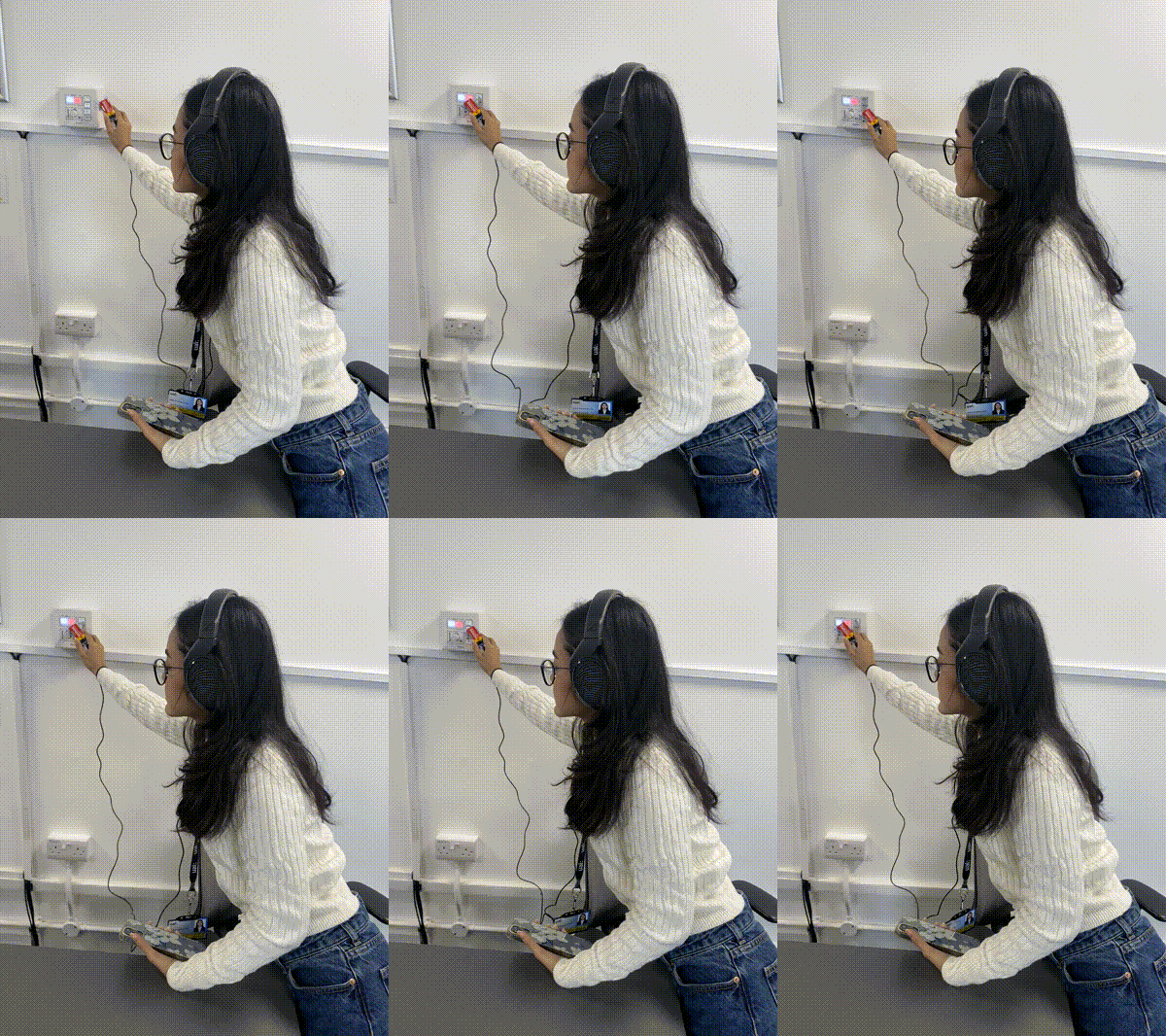


Fig. 2 the electro ears device. Fig. 3 Rania testing the electro ears within the classroom. Fig. 4 starting our prototyping of a low fi wearable with only paper. Fig. 5 first prototype laser game using Electro Ears for navigation. Fig. 6 our prototype combined with another teams.
Exploring Balance
We visited Mithraeum Temple on Saturday to explore Balance. From Rania suggestion we wrote our thoughts on a collaborative presentation for discussion on Monday.


Fig. 7 images of arefacts found within Mithraeum Temple. Fig 8. Mithraeum temple.

Fig. 9 my thoughts on balance from The Pavilion exhibition by Pamela Phatsimo Sunstrum at Mithraeum

Fig. 10 My thoughts on balance from the Mithraeum temple

Fig. 11. Questions and ideas after exploring Mithraeum and balance
LCC Workshops
I attended a creative coding workshop where I explored P5.J and I used this library to create a drawing tool. This tool was reactive to mouse movements to create simplistic abstract drawings using a range of different colours.
I also attended a Collaboration workshop. This workshop provided advice on dealing with conflict in the creative industry, we also looked at how we could work together to design for the future. I utilised outputs of this workshop in class on Thursday, when creating a “manifesto” on how our course group should work together.
What I learnt
When ideating the paper wearables, we got stuck overthinking and doing little so when we were given 10 minutes to make something we felt a lot of pressure. However, this forced us to use the process of making to visualise ideas and find a common ground. I would like to continue this approach throughout this brief.
Through exploring Mithraeum Temple i was able to look at balance beyond the human body giving me a fresh perspective. It reminded me that the creative process can go beyond googling and brainstorming on paper.
The creative coding workshop allowed me to explore my creative thought process in a field I had previously engaged with in a logical systematic way. I am looking forward to delving into it deeper.
Finally, collaboration has been key to this week. I’m learning to avoid my own knee jerk reactions to someones ideas based on my own biases and instead exploring others ideas, testing them out and responding constructively.
Week 2 Monday 9 October - Sunday 15 October
Ideating balance
As a group we explored how the Mithraeum Temple shaped our views on balance. I facilitated a synthesising exercise, where we wrote down what balance meant to us and grouped common themes together creating 3 categories. We decided physical balance was the category we wanted to focus on.

Fig. 12 Team thoughts on balance synthesised into 3 categories, physical, spiritual / spatial and symmetry.

Fig. 13 We picked physical balance to focus on.
Prototyping and research
I looked into what could impact balance and came across a study which suggested conflict between the vestibular, proprioceptive and visual systems leads to imbalance, particularly when cues differ between these systems (Redfern et al, 2001). Another study showed balancing a book on your head can improve balance and stability (Malmström, 2016). This research suggested to me balance can be conscious when there is a chance of imbalance.
From this research we wanted to prototype a device which brings our sense of balance into consciousness by exploring the physical symptoms of losing it. We drew concepts before prototyping a device that balanced via its centre of mass. We explored this as a headpiece in a second prototype.


Fig. 14 & 15 ideation on paper

Fig. 16 Prototype one a device that balances by centre of mass

Fig. 17 Prototype two a headpiece that balances by centre of mass
Consolidating, refining and presenting
We revisited our experience at Mithraeum and remembered how the darkness of the temple caused us to feel imbalanced, so we decided to inhibit vision in our final device, the device also included scales to monitor the persons sense of imbalance. We presented to the rest of the group on Thursday for feedback.


Fig. 19, 20 and 21 images of final experience
Fig. 22 Video of final experience

Fig. 23 script for roleplay presentation
What I learnt
I enjoyed exploring how others perceived the Mithraeum temple discussing this gave us a shared perspective and the synthesising activity helped us come to a consensus on our concept.
In our presentation we received the feedback that our experience was quite a literal representation of balance and I agree. We could have been more creative and explored balance / imbalance on a deeper level. In the future I would like to do this through additional primary research, for example, we could have gone and observed people doing activities that require balance or asked people how it feels when they are in a state of imbalance. This may have given us insights that could have shaped our experience.
Finally, in future presentations I’d like to showcasing our ideation and design process more to demonstrate the depth behind our design. During the presentation an audience member tried the device, this was great live feedback that I’d like to incorporate in future presentations too.
References
Malmstrom, E., Kronkvist, M., Tjernström., F (2016) Balancing a book on the head affects postural control', Otorhinolaryngology-Head and Neck Surgery, 2(2), pp. 131 -136 Available at: 10.15761/OHNS.1000133.
National Health Service Tayside (2016) Balance skill activities advice sheet. Available at: https://www.nhstaysidecdn.scot.nhs.uk/NHSTaysideWeb/idcplg?IdcService=GET_SECURE_FILE&Rendition=web&RevisionSelectionMethod=LatestReleased&noSaveAs=1&dDocName=prod_255380#:~:text=Children%20develop%20balance%20skills%20from,the%20development%20of%20good%20balance (Accessed: 10/01/2024).
Redfern, M., Yardley, L., Bronstein., A (2001) 'Visual influences on balance', Journal of Anxiety Disorders, 15(1-2), pp. 81 -94 Available at: https://doi.org/10.1016/S0887-6185(00)00043-8

